
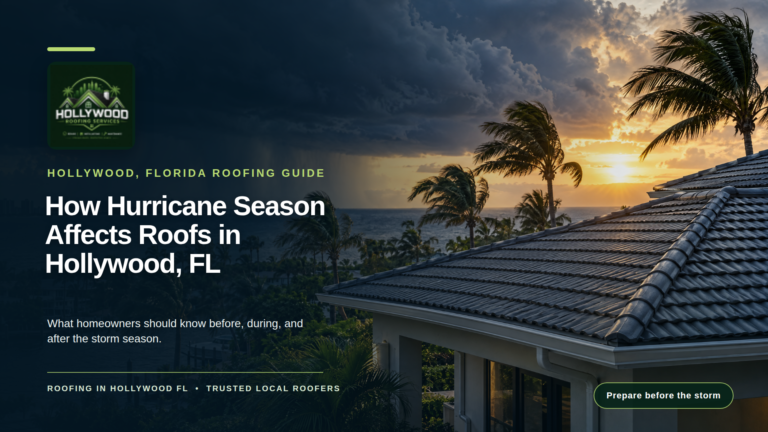
Around the end of May, people of Hollywood get busy. Shutters come out of the garage. Somebody’s always hunting for the flashlight. The water jugs get filled. What almost nobody does is walk outside and look at the roof, even though hurricane season roof damage costs homeowners more than most of that other stuff put together.
We spend our days on Hollywood roofs, so we’ve got a good idea of how a season plays out. Some roofs come through fine. Others give up on the first windy night. This post is about the difference, and what you can do about it.
The Season Is Long
Hurricane season runs June 1 through November 30. Six months. That’s a long time for a roof to stay on alert.
And it isn’t only about the big, named storms. We also get tropical rain bands, wild gusts and those afternoon thunderstorms that come out of nowhere. Every one of them pushes on your roof a little. A weak spot might survive the first three and quit on the fourth.
So a lot of roof trouble shows up late in the season. It builds up slowly.
What Wind Really Does
Most of us picture wind shoving the roof sideways. The real trouble is lift. Wind blows across the top of the building, creating a suction force much like the suction created by a wing in an aircraft. There is an upward lifting action on the roof.
It’s at the edges that the wind has its bite, and here shingles lift up and come loose, tiles loosen, and metal sheets may be warped due to weak fastenings. In the case of a flat roof, the roof covering will simply peel up at the edges.
One piece detaches and another follows suit. A storm rarely takes the whole roof in one go. It starts at a corner and works its way across.
Hollywood sits in Broward County’s High Velocity Hurricane Zone, which has some of the toughest roofing rules in the country. They help a lot. But they only work if the roof was built to those rules and kept in decent shape.
Sideways Rain
In a hurricane, the rain doesn’t fall. It flies. Wind pushes it sideways and up, into places a normal shower never reaches. Under flashing. Around vents. Up behind the edge of a tile.
You can’t always see it. The roof looks okay from the street. But a small gap near a pipe has been letting in a trickle all night. Three days later there’s a brown spot on the bedroom ceiling, and by then the wood and insulation above it are soaked.
People imagine hurricane season roof damage as a big hole. Honestly, a lot of it is a slow leak that started during the storm and kept going after.
Flying Stuff, Falling Trees
Wind turns everyday things into missiles. Branches. Coconuts. A neighbor’s lawn chair. Loose pieces off another roof. Any of them can crack a tile or punch through a shingle.
We’ve got a lot of trees in Hollywood, and we love them. They’re also the reason we get so many calls after a storm. One heavy limb can leave a dent, or a hole right through to the attic.
On flat roofs, it’s usually loose equipment. A poorly fastened vent or AC cover can slide across the roof in a gust and slice the surface as it goes.
Our Weather Wears Roofs Down
There’s more to the storm itself. Being that we are near the water, the salty air is working on any metals that are out. The sun is constantly attacking our roof. The constant moisture allows for algae and causes sealants to deteriorate.
So when a storm arrives, a Hollywood roof has often been through a lot already. It’s like asking someone to run a race right after a long, hot day of work. That’s why roofs here sometimes look older than the date on the paperwork.
Which Roofs Handle It Best?
No roof is storm-proof, but some do better than others. A lot depends on how well it was put on. Here’s a rough picture.
| Roof Type | How It Often Holds Up | Common Storm Trouble |
|---|---|---|
| Asphalt shingle | Fine when new, weaker with age | Lifted or torn shingles, loose edges |
| Concrete or clay tile | Strong but heavy and brittle | Slipped tiles, cracks from debris |
| Metal | Often good when fastened well | Bent panels, loose screws, scratches |
| Flat roof | Depends on drainage and edges | Peeled edges, ponding, torn surface |
See how every type has a soft spot? That’s why a checkup before the season matters more than which material you picked.
Age Counts
A 25-year-old roof and a 5-year-old roof aren’t in the same league. Sealant dries out. Nails loosen up. Materials get brittle. The Florida sun does that to all of them.
If your roof is halfway through its expected years or more, the odds go up that it’ll struggle in a storm. We’re not saying that to scare you. It’s just what we see on the job. Insurance companies look at age too, so it’s worth knowing where your roof stands.
Peek in the Attic
Here’s a cheap trick most people never try. When it is not raining outside, take a torch to the attic and check out whether there are any spots on the roof that may be dark or even moist. A musty smell means moisture has been getting in.
The attic tells you things the roof can’t. We’ve found problems up there that the outside never showed. Spend ten minutes now, and again after a storm, and you’ll catch trouble early.
Before June Arrives
The best time to fix a roof is on a clear, boring day. If it were our house, here’s what we’d do in spring.
- Book an inspection
- Repair loose, cracked or missing pieces
- Clear gutters, drains and valleys
- Cut back overhanging branches
- Check flashing at vents, chimneys and skylights
- Look for dried-out sealant
- Secure or remove loose items on flat roofs
- Take dated photos while the roof is in good shape
That last one gets skipped a lot. If a claim ever comes up, photos from before and after make your case stronger.
Roof work here also needs a permit and inspections. If someone offers to skip that, find someone else.
When a Storm Is on the Way
By now, the roof work is done, or it isn’t. Either way, the job at this point is staying safe.
Please don’t climb up to tie something down or throw a tarp over it. Wind and wet surfaces are a bad mix, and it takes one second to get hurt. A roof can be repaired. You can’t.
Bring in loose stuff from the yard so it doesn’t fly. Take a few last photos if you have time. Then stay inside.
After It Passes
Once it’s safe to go out, walk slowly around the house and look up. You don’t need a ladder. Watch for these.
- Missing, cracked or lifted shingles or tiles
- Bent or loose metal at the edges
- Branches or objects sitting on the roof
- Roofing pieces lying in the yard
- Dips or sagging spots
- Water stains on a ceiling, or damp spots in the attic
Photograph everything. Don’t throw anything away until it’s been documented.
Then call someone to look at it soon. A small opening can let in rain every afternoon for a week.
Mistakes We See
Same few slip-ups every year, so we’ll just say them.
- Climbing on the roof to have a look
- Waiting a few weeks to see if the stain gets bigger
- Tossing the broken pieces before taking pictures
- Hiring the first person who knocks on the door
- Smearing cheap sealant over a problem and calling it fixed
Each one tends to cost more later. Slow and careful wins here.
Keeping the Water Out
If there’s a roof problem, then the first thing that needs to be done is to prevent more water from getting in. This means that there needs to be some kind of covering applied by a professional.
This is not the actual repair. However, it’s important since it prevents water from getting into your home and causing mold damage and high costs. It’s also what insurance requires from people to do after an accident happens. Always keep all the receipts of temporary work.
Insurance Basics
Storm insurance gets confusing fast, so here are a few general points. They aren’t advice for your own policy. Lots of Florida policies have a separate hurricane deductible, often a percentage of the home’s value. That can be a big number. Read it ahead of time when it is still sunny, not during the storm. Damage must be reported as soon as possible because claim limits are usually shorter than most realize. Your agent can tell you what applies.
One more thing. If a contractor says they’ll cover your deductible, be careful. In Florida, that’s against the rules.
How We Handle Storm Repairs
This is how a storm repair usually goes, so nothing surprises you. We start with an inspection and take photos of the damage. We note what came from the storm and what came from age or earlier wear, because that difference matters to an insurer.
If water is getting in, we cover the roof temporarily. Then you get a written estimate that explains the repair. We take care of the permit. The repair goes in, the inspector checks it, and we clean up the yard and sweep for nails.
If the roof is too far gone to fix, we’ll say so and go over replacement options. Better you hear it from us now than find out in the next storm.
Beware of Storm Chasers
After a big storm, crews from out of town show up and knock on doors. Some are fine. Others take a deposit and vanish, or do rushed work that fails in the next blow.
Before anyone touches your roof, look up their license and ask to see their insurance. A local address and a few past customers you can call say a lot. Keep every promise in writing, and don’t let anyone rush you into signing. A decent roofer will wait.
What We Do
Roofing in Hollywood FL helps homeowners with roof inspections before and after storms, storm damage repair, emergency tarping, leak repair, roof replacement and help with permits and insurance paperwork. We know what local storms do to local roofs.
Sometimes a roof needs just one repair, and we’ll be the first to tell you. When it needs more, we’ll walk you up to the damage, show it to you and explain the reasoning.
Frequently Asked Questions
When should I have my roof checked?
Ideally in spring, before the season starts, and again after any strong storm. A small problem costs less when it’s caught early.
Can I tarp my own roof?
We wouldn’t. Wet roofs are slippery, and the wind can suddenly pop up. It is up to the experts.
How soon do I need to notify my insurance company about damage?
The sooner the better. There are deadlines on filing claims, so give your agent a ring and find out what he needs.
Can a roof leak several days after the storm?
Indeed. Water could seep into all those layers and emerge days later. Inspect ceilings and attics several days after the storm.
Is it worthwhile to fix minor damage before a storm?
Yes, indeed. Those gaps are where wind and water start getting in. A relatively inexpensive fix could save you from a much more expensive fix.
What are the signs of hurricane season damage to a roof?
Buckled, loose or missing shingles or tiles, bent metal, damaged edges of a flat roof, leaks around vent pipes and damage caused by falling branches and other debris.
Final Thought
In hurricane season the roof works hardest and most silently. How to protect your roof? Just inspect it before the season and fix minor damage, then inspect it again after any storm.
Not sure how your roof will hold up? Roofing in Hollywood FL is happy to take a look. Ask us anything. You’ll get honest answers and a clear idea of your next move.
- How to Decide Between Roof Replacement and Roof Repair - October 14, 2026
- How to Decide Between Roof Replacement and Roof Repair - October 13, 2026
- Top 5 Signs of Roof Damage Homeowners Often Miss - October 13, 2026