
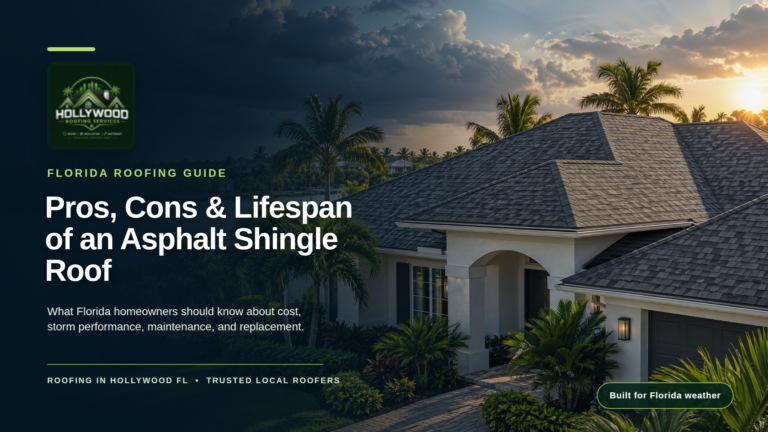
Let’s be real for a second. Most of us don’t think about our roof until something drips on the kitchen floor. Then it’s all we think about.
If your house has shingles, or you’re about to pick them for a new roof, this post is for you. We spend our days on Hollywood rooftops, so we’ve got a pretty good idea of what shingles can handle down here and where they give up. No sales pitch. Just what we see.
By the end you’ll know the good points, the weak spots, and how many years an asphalt shingle roof in Florida can really give you.
Quick Look at How Shingles Work
A shingle is simpler than you’d think. There’s a fiberglass mat in the middle. It’s coated in asphalt, which is what keeps water out. On top, there’s a layer of tiny stone chips called granules.
Those chips matter. They act like sunscreen for the asphalt. When they wear away, the sun gets straight to the asphalt and starts drying it out.
Shingles overlap each other, row after row, a bit like scales on a fish. Rain hits the top row and runs down over the next one, all the way to the gutter.
You’ll also run into a few different grades when you shop around.
- Basic flat shingles. Thin and cheap. They’re fine for a tight budget, but they don’t stand up to wind as well.
- Dimensional shingles. Two layers bonded together. Thicker, sturdier, and the most common pick these days.
- Heavy-duty shingles. The thickest of all, with longer warranties. A few styles copy the look of wood or slate.
What We Like About Them
Start with the price. Shingles usually cost the least of any roof you can put on a house. If your old roof is leaking and money is tight, that’s a big deal. A roof that’s paid for beats a fancy one you can’t afford.
They’re quick, too. Most homes get finished in a few days. Here, where it can pour at 3 p.m. like clockwork, a short job is a real plus.
Repairs are simple. A tree limb knocks off a handful of shingles? We swap those and leave the rest alone. Can’t always say that for tile.
And they’re light. Your house doesn’t need extra support to hold them up, which keeps the job easy.
What Gives Us Trouble
Okay, now the part that doesn’t make it to the brochure.
The sun is the biggest problem. Day after day, it cooks the shingles. The granules dislodge and drain to the gutters. Ever seen those piles of sand-like particles in your downspout? Your roof is simply sloughing off its sunscreen!
Now comes the wind. Each individual shingle fastens to the shingles below it via nail and an adhesive strip that partially melts when exposed to heat. The adhesive strip could be worn out or never fully bonded, in which case, a high wind could get underneath it. One goes, then the next.
Then there’s the damp air. Algae grows on roofs here and leaves those dark streaks. It looks bad more than it does harm, but it does keep moisture sitting on the surface.
And finally, the lifespan. Compared to tile or metal, shingles just don’t stay on the job as long in this weather. That’s the price of the lower cost. None of this means “don’t buy shingles.” It means to look after them.
Years You Can Expect
Check the box on any bundle and you may see 25 or 30 years. Take that with a grain of salt. Those numbers don’t come from a Florida summer.
Here’s what we tell folks instead. It’s our own rough guide, so think of it as a ballpark and not a promise.
| Type | Years Here (Ballpark) | Wind Holding Power | Cost |
|---|---|---|---|
| Basic flat | 15 to 20 | Lowest | Cheapest |
| Dimensional | 20 to 25 | Good | In the middle |
| Heavy-duty | 25 to 30 | Best | Priciest |
Lots of things can shift those numbers. Which way your roof faces matters. So does the attic. So does the person who nailed it down.
Why Some Roofs Quit Early
We’ve pulled plenty of roofs that should have had five more good years. Most of the time, it came down to something avoidable.
- An attic with poor airflow, so heat piles up under the shingles
- Not enough nails, or nails put in the wrong spot
- Worn-out flashing around pipes and vents
- Gutters stuffed with leaves and water backing up
- Branches brushing the roof in every breeze
- A big storm came through and nobody checked the roof after
That nail one is worth a second look. A roof can seem perfect from the street and still be barely hanging on. Ask your roofer how many nails go in each shingle. If they can’t say, that tells you something.
Shingles and Hurricane Season
This is the question underneath all the others. Will it hold when a storm comes through?
A well-installed dimensional shingle roof can handle a lot of wind. Look for the wind rating printed on the package, and make sure the product has the approval our area requires. The rating only counts if the nails and the sealing strips do their job, though.
What shingles can’t do is shrug off flying debris the way heavier roofs sometimes can. After any storm, even a mild one, take a walk around and look for missing pieces. Take photos too. If you ever file a claim, dated pictures help a lot.
Does It Pay Off Over Time?
Short answer: sometimes.
Say you put on shingles now and again about twenty years later. A neighbor with a metal roof might pay only once in that stretch. So over the long run, the shingle owner can end up spending more, even with the cheaper start.
But a lot of people don’t plan that far. Maybe you’re selling in six years. Maybe you just can’t write a big check today. Those are fair reasons, and shingles fit them well.
One more thing. Materials and labor keep getting pricier, so the next roof will likely cost more than today’s.
Insurance and Your Roof’s Age
You’ve probably noticed how much Florida insurers care about roofs. Some want proof an older roof is still in good condition. Some won’t cover one past a set age. The rules have bounced around lately, and every company does its own thing.
So pick up the phone and ask your agent where your roof stands. While you’re at it, ask about a wind mitigation inspection. It documents how your roof is built and tied down, and that can lead to a discount. A newer shingle roof with solid nailing often does fine.
Is Your Roof Telling You Something?
You don’t have to climb up. Just walk the yard on a clear day and look.
- Corners curling up or the middle of a shingle dishing in
- Cracks, bare spots or shingles that are gone
- A lot of grit in the gutters
- Brown rings on a ceiling
- Streaks that keep coming back
- Spots of daylight in the attic
One or two might just need a patch. Several at once? Your roof is probably nearly done.
Patch It or Redo It?
This one comes up all the time, so here’s how we think about it.
Is the roof still fairly young, and is the trouble in one spot? Patch it. Wind took off a few shingles in a storm? Patch it.
Is the roof past the middle of its life, and are leaks popping up in new places? Then you’re probably throwing money at it. A new roof will likely cost you less than another round of fixes.
Here’s a rule that works. If you’ve called a roofer out three times in two years for the same roof, it’s time to ask about replacing it.
Little Things That Buy You Time
This isn’t heavy work. An hour or two a year does a lot.
- Get the roof checked once a year, and again after a big storm
- Clean the gutters before hurricane season
- Trim branches away from the roof
- Rinse off algae gently, and keep the pressure washer in the garage
- Fix little problems before the next downpour
A lighter shingle color helps too. It bounces more sunlight, so the attic doesn’t get quite as hot. Some shingles also come with cool-roof coatings.
What a Good Install Looks Like
You can buy the best shingle on the shelf and still end up with a bad roof if the crew rushes. So here’s the order a careful job follows.
The old roof comes off to bare wood. We look it over, and any soft or damaged boards get replaced. Next, a water-resistant sheet goes over the deck. That’s your backup if water ever gets past a shingle. Then the metal edging and flashing go in around pipes, vents and walls. Last came the shingles, nailed the way the maker says they should be.
Before any of that, there’s a permit. In Broward County, a roof replacement needs one, plus inspections. The products also need approval for our high-wind zone. A roofer who says “we can skip the permit and save you money” isn’t doing you a favor.
When We’d Say Go With Something Else
We install lots of shingles and we’re happy to. But they’re not right for every house.
If this is your forever home, a tile or metal roof may cost less in the long run. If you’re close to open water, salt and gusty wind can be hard on shingles too.
Then again, if you want a decent roof at a fair price, or you might move in the next ten years, shingles make good sense. Pick based on your plans, not on what’s popular this year.
How Roofing in Hollywood FL Can Help
We work all over Broward County, so we know what the weather does to roofs here. For this topic, we do roof inspections, shingle repairs, leak and storm fixes, and full shingle roof replacement. We’ll also help with the permit and the photos and paperwork your agent may ask for.
If your roof is in good shape, we’ll tell you. If it isn’t, we’ll show you what we found and go over your options. When you hire anyone, check their license, ask to see their insurance, and get the job details in writing.
Frequently Asked Questions
So what do you mean when you say your roof is a “30-year” shingle roof?
Usually, not much. That’s a warranty term and has nothing to do with Florida weather. Expect a shorter lifespan.
What is the least expensive way to make my roof last longer?
Do your maintenance. Regularly cleaned gutters, trimmed trees, and an annual inspection will take care of any little problems.
Does shingle color have anything to do with my air conditioning costs?
It does a little. Shingles that are light colored or cool coated will reflect more heat. Insulation in your attic is another factor.
How long should I wait before checking my roof after a storm?
Soon after, if at all possible. Most water damage to roofs occurs through minute holes in your shingles and can be hidden in your attic.
Can I replace just one area that’s damaged?
Most likely, as long as the other areas of your roof are still in decent condition. The roofer will determine this.
Will a new shingle roof help my insurance?
It might. Many insurers look at roof age and condition, and newer roofs tend to score well. Your agent can tell you what they offer.
Final Word
So where do we land? The shingles are cheap, fast to install, and very easy to repair. Our climate makes the shingles have a shorter lifespan than they could otherwise, so choose the right type and ensure correct installation. With those steps taken, you will soon have your own quality asphalt shingle roof in Florida.
Not sure how your roof is doing? Roofing in Hollywood FL is glad to take a look and tell you what we see. Give us a call and we’ll help you figure out your next step.
- How to Decide Between Roof Replacement and Roof Repair - October 14, 2026
- How to Decide Between Roof Replacement and Roof Repair - October 13, 2026
- Top 5 Signs of Roof Damage Homeowners Often Miss - October 13, 2026